To view the latest from Ridge Berry Farm visit our new blog and site!
It's Spring time and of course, this means our Tea Room is re-opening for the 2016 season. We will be open as of tomorrow, March 22nd. Our hours are Tuesday to Sunday, 10AM to 6PM.
Spring time and the tea pots are blooming! Ready for the 2016 Tea Room Season.
We've updated our menu a touch. As promised, we've replaced our (unsustainable) Tuna salad with Niagara Coronation Chicken. This is our own version of a UK classic, using a chutney made from local Peaches. We've also now sourced our drug-free and hormone-free meats from sustainable farmers.
We've also made some significant upgrades in our egg procurement. We have finally found local eggs we can use in our restaurant (Provincial regulations mean they have to be graded). These eggs are somewhat more expensive but well worth the difference in price. The multi-coloured eggs are from free-range heritage varieties locally farmed by Bertha's Bounty. You can tell the difference in quality just by the strong egg shells and the large orange yolks. We're really looking forward to using these.
Finally! A local source of high quality eggs (Bertha's Bounty)
Meanwhile, elsewhere on the farm, it is Maple syrup season. We've been collecting our sap (this year a lot earlier than before). In fact, we'll be switching to Birch soon and this is a few weeks ahead of last year, given the Spring like weather we faced in February.
Spring like weather has made it easy to collect sap this year.
We'll close by suggesting to everyone that it is now time to visit your local "sugar bush". A good place to visit in Pelham would be White Meadows, where everything they do is Maple themed.
To view the latest from Ridge Berry Farm visit our new blog and site!
March is upon us and this means Spring...it also means the Tea Room will be re-opening soon! Many have asked when this will occur and we're happy to say Tuesday, March 22nd. For this new season, we will be open 10AM to 6PM, Tuesday to Sunday. We will be closed on Mondays.
It is now time for us to get out of hibernation and get ready! Over the coming weeks, we'll be working on updating our menu and trialing some new items for the upcoming season.
Although, we've not accomplished much this Winter, we still managed to get the first phase of our barn restoration completed. Finally, the back half of the barn is looking a lot more "civilized".
The back of the barn was looking a little sad...
...a face lift has provided it with new life.
There is still much to be accomplished in the interior, but this is a great start, Our ultimate objective is to have a patio where guests can dine overlooking the berry fields.
Although our Winter was a lazy one, we did manage to discover and develop a few new things. One of these is a "white" wine made with (of all things) Raspberries.
Of the new berries planted in our fields, the most difficult to use has been the Yellow or Golden Raspberries. They taste great and are very similar to their red counterparts. However, when cooked, they turn brownish and are not exactly appetizing, Although tasty, even the associated jams and jellies tend to take on this darker colour.
Since our plot is generating quite a few berries each year, we have more than we can use. This Winter, we were left with a reasonable amount that we ended up freezing for long term storage.
We decided that one option might be to transform these into wine.
Delicious golden raspberries ready to be transformed into wine.
The result, has surprised us completely. We ended up producing a distinctive white wine. The bouquet is all Raspberry and so is the taste. Not as sweet or "liquory" as some of the other fruit wines we've been playing with, this wine is perhaps the best we've managed to produce to date.
A Raspberry "white wine", perfect accompaniment to....chocolate!
We'll close this week with one thing that we were able to accomplish during this rather warm Winter: pruning. The lack of snow and bitter cold weather meant that a few days could be spent catching up on our pruning...although we still have a heck of a lot more to do!
To view the latest from Ridge Berry Farm visit our new blog and site!
In the past, we have let some of our property for commercial bee keeping, hoping to eventually do this ourselves. This year, we decided to start on a very small scale. Of course, not satisfied with doing anything the traditional way, we wanted to try out some new apiary technology.
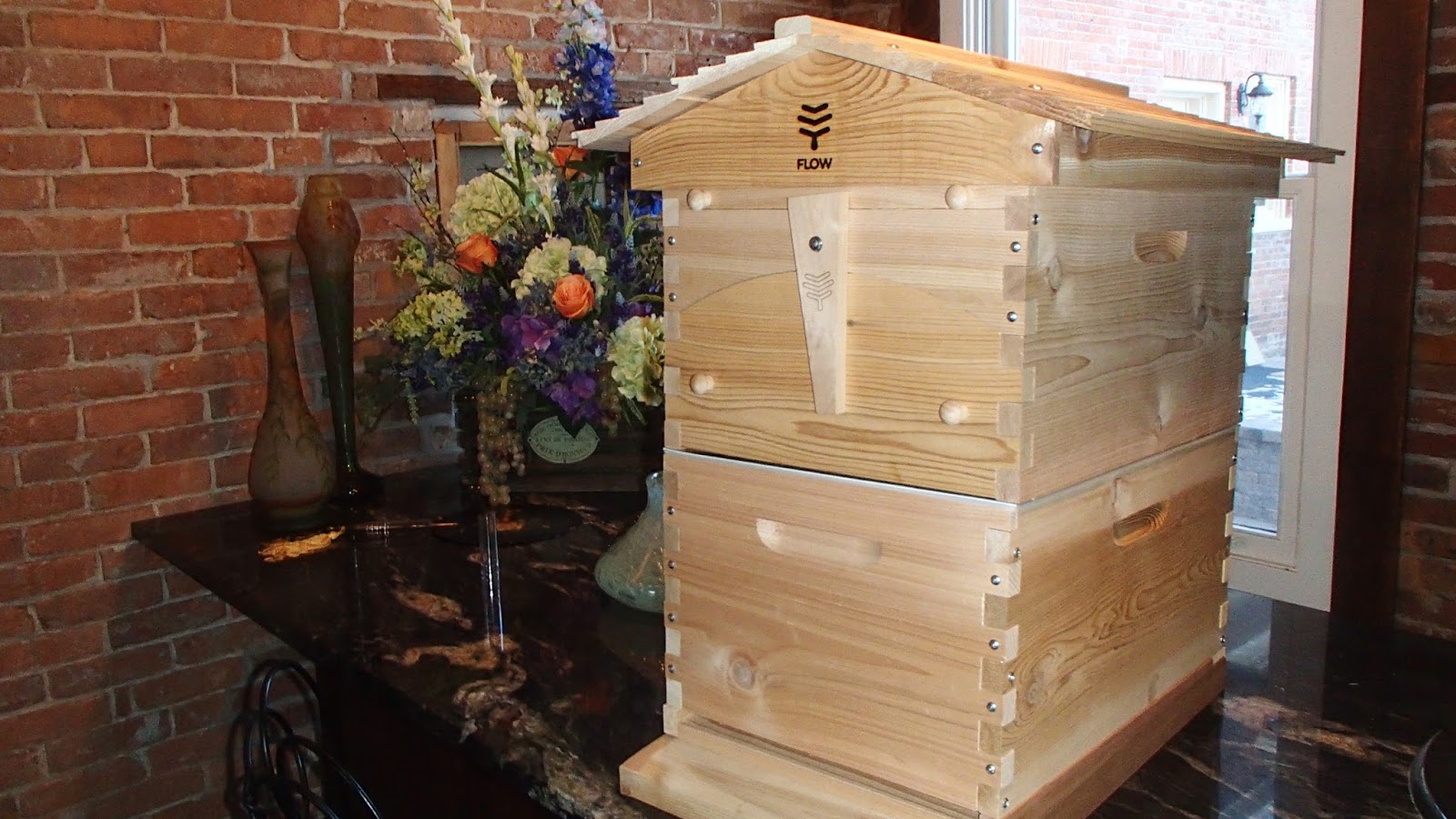
Our new assembled Flow Hive
Last year, a father and son team from Australia launched a crowd funding campaign for a concept they had developed. This involved a bee hive, called a Flow Hive, which would allow the beekeeper to collect honey from the combs without the removal the combs from the hive or the use of centrifuge to extract the honey from the combs. We were intrigued and after a bit of research we were compelled to be one of their original backers. We were definitely not alone and their crowd funding campaign exceeded all expectations, raising much more than originally anticipated.
This month, as original supporters, we were rather thrilled to get our first Flow Hive. The entire hive came in two neat packages and required quite a bit of construction. It was a bit like an Ikea kit. Based on recent Ikea experience, we would have to admit this was of better quality. The instructions were well detailed and after a morning of construction we were pleased with the results.
From the Flow Hive kit, a brood box takes shape.
The only two issues we did face during assembly was a brood box panel which was not pre-drilled and an access door which was rather tight.
The key to this technology are plastic frames which sit on top of the brood box. These frames are composed of multiple partially finished plastic cells. Bees will eventually complete these cells with wax and fill them with honey.
The critical element to the Flow Hive
Once the hive is assembled, two access panels or doors are used to collect the honey. On the top is a slot in which a long key is inserted. In the bottom is a collection tube. Once turned, the key splits the combs and the honey flows to the collection tube.
Accessing the Flow Hive frames for honey collection
A couple of added niceties for being original supporters of the concept, were a wood burned recognition on the hive's access window panel and a beekeeper's hat which was sent with the kit.
Already feeling like a beekeeper
Of course we will be augmenting this hive with a couple of more conventional units. However, our first experience with this particular model would suggest that this may be the ideal hive for the hobbyist. We will now need to assess it with a bee colony and their honey to give a final verdict.
For those wishing to know more about this technology here is the Flow Hive web site. Below, you will also find one of their videos which really explains the concept.
It's now time to educate ourselves on beekeeping and get some colonies!
To view the latest from Ridge Berry Farm visit our new blog and site!
2016 finally begins with snow on the ground. The holiday season is over, but we'd like to share a couple of cooking experiences which may be of interest to our readers.
As most blog readers know, our favourite holiday meat is goose. To end 2015, we decided to take a different path to cooking goose. Our Slow Food event for Terra Madre last month was based on deboned quails. We decided to use what we have learned to debone our goose and effectively create what the french call a "ballotine".
The results were amazing. By keeping just four bones (2 leg bones and 2 wing bones) we were able to create a "ballotine" that still resembled a roasted goose and yet had no carcass. Cutting this large bird in half proved impressive and very easy to serve. We'd recommend everyone at least try this once with a roasted bird. There are ample videos on YouTube; in particular, we would recommend those published by Chef Jaques Pepin.
A "re-constructed" bird; "ballotine" of goose
Always impressive to cut a boneless stuffed bird in half.
For New Year's eve, we decided to draw on the Polish side of the family for a different cultural tradition: Bigos.
Since arriving at the farm, we have been practicing and promoting on this blog home made sauerkraut. Yet once made, what is the best way to enjoy this great food during the Winter season? Our answer is Bigos; also known as a Polish hunters' stew.
Bigos is a national Polish dish, yet its roots are in Lithuania. In 1385, newly crowned king Wladyslaw Jagiello, originally from Lithuania, introduced the concept to his court and featured it as part of his hunting parties.
The concept is simple, yet we're certain that for every Polish family in North America, there is a different version of Bigos. In fact, we would not be surprised if something similar can be found in many North Eastern European countries and tradition.
Basically Bigos is a combination of sauerkraut and meats. To this are added onions, mushrooms, and sometimes tomatoes and cabbage. The essential meat to this meal is of course Kielbasa (that wonderful garlicky Polish sausage).
For us, we decided to use local meats to add to our Bigos. This included pork loins (which we braised in white wine), pork belly (bacon can also be used), and smoked pork chops (Kassler) which were added to our Kielbasa. Locals can source great meats for this meal at the Country Corner Market in Welland (this includes Kassler and Kielbasa).
New Year's Eve Bigos
If you have home made sauerkraut at hand, we highly recommend making Bigos. There is nothing heartier as this wonderful Winter stew and every element of it reflects our own local Ontario food culture, since our climate is so similar to northern Europe.
Finally, on the farm, it is now time to tackle our barn project.
Before much can be done structurally, we actually have to clean up a horrendous mess. This is an accumulation of "stuff" which existed in the barn when we moved in, plus a large amount of our own things. "Stuff", lots of stuff, we've not even yet bothered to sort through from our various moves over the past 10 years.
The barn: a mess that needs to be sorted through
Progress has been slow, but things are starting to look good. In the process, we've even found a few historical artifacts from the farm. These we hope to display in our Tea Room and Market this year.
To view the latest from Ridge Berry Farm visit our new blog and site!
Although this has been an exceptionally warm December (and we have no snow on the ground), it's already time for the Holidays. We would like to take this opportunity to wish everyone a very happy holiday season and a prosperous New Year.
Happy Holidays from all of us at Ridge Berry Farm
For us at the farm and tea room, this means we are now closed for the season. As such, we would like to also thank our guests and patrons who have made this year our best so far. The Tea Room will be open once again in the Spring, with a planned re-opening date of March 22, 2016.
The seasonal closing of the tea room actually gives us time to catch up on our farm work, clean up the Tea Room kitchen (from top to bottom), and experiment with our anticipated new additions to the menu. For example, one item we have been working on is a beautiful apple tart with almond paste.
Made with local apples, these tarts are not only pretty...but delicious!
It is also the time to begin the second phase of our barn renovation. This entails fixing the foundations, demolishing an old crumbling addition, re-finishing the exterior and insulating the lower back half of the building. In the past few weeks, work on the foundation was already started.
The beautiful stone foundations in the back of the barn are now undergoing restoration
Ultimately, we hope to have more insulated storage space for the market, an extended kitchen (we really need more space)....and a new oven! Our old oven failed us this summer and for the past few months, we have been working from a small (but very capable) cafeteria oven. It's time to increase our capacity and our capability.
We'll close this entry by announcing that the old Victorian manor is finally back in the news and reclaiming its conservative splendor. In 1880, the Victorian Tribune called it a "testament to the fellow's good taste", referring to Josiah Ward. This month and 135 years later, it is back in the news and showcased in the Niagara winter edition of Our Homes magazine.
Want to know more abut the house? Check out the latest edition of Niagara's Our Homes magazine
Next year, plans are in the works to have at least a couple of Tea Room events centered around the Victorian manor and the property's rich history.
To view the latest from Ridge Berry Farm visit our new blog and site!
First, we'd like to take this opportunity to wish all of our American friends a very happy Thanksgiving.
For us in Niagara, this was the week of our first real snowfall of the season. It did not last long on the ground as we've been enjoying an amazingly warm November. It did however usher in the Christmas spirit.
Our first snowfall of the season....
The warm November was a bit of a godsend for us. Being busy with the Tea Room, our farm duties have been neglected. The nice weather allowed us to clean up our raised beds, while collecting seeds for next Spring (beans, okra, some annual herbs, pumpkins, etc. are so much fun to gather).
This was also the time to "hunt" for the Asparagus that grows wild on the property. This time of year they stand out like delicate yellow-green ferns. We look for these to simply transplant in our Asparagus bed. Slowly, this bed is getting full and should produce a sufficient amount of Asparagus next Spring (perhaps not enough for the restaurant, but certainly for the family),
A beautiful, delicate fern; Asparagus growing wild on the property.
The Growing Dome project has not progressed this year, however the dome is still producing some great Zucchinis from a very large plant that is still to this day flowering. One way or another, this set up is really showing signs of possibilities....if we could only get our Aquaponics system set up!
Another surprise has been the Water Spinach, a new plant we have been working with this year. Being semi-aquatic, we transferred some cuttings from our raised beds directly into the Growing Dome water tank. Not only are the plants surviving, but they have generated a significant root system and have started to grow. This plant may be ideal for the Aquaponics set-up and may prove hardy enough to withstand Winter in the Dome.
Zucchini flowers in November...thanks to our Growing Dome.
The Water Spinach cuttings are also doing rather well
At the Tea Room we're now preparing for our next event: the Slow Food Terra Madre celebration on December 16th. If you are not familiar with Slow Food please check out the website. The local group based in Pelham and now known as Slow Food Niagara is a small but thriving community of like minded people (ie. foodies that are concerned about the impact of "industrial food" and wishing to promote local, sustainable products).
For the Terra Madre celebration, we will be doing a main course of Quails. So for the team, it was time to practice our de-boning skills (real Chefs make it look so easy!). We certainly had a fun time getting a lot more acquainted with the anatomy of a bird.
Time to work on our de-boning skills
We'll close this week with a quick photo of the Carolinian forest in the Fall (our favourite part of the property).
Not a conifer in sight....the Carolinian forest in the Fall.
To view the latest from Ridge Berry Farm visit our new blog and site!
It is Sunchoke season!
It's amazing, but very few locals would know what we're talking about. Also commonly known as Jerusalem Artichokes, they are sold as very expensive "exotic" food in the "big city".
Our first harvest of the year.
The reason we are amazed is that this wonderful food is actually indigenous to Niagara. You can often see these beautiful tall yellow flowers growing in the ditches between here and Simcoe county. They were at one time a great source of food for the native Canadians (Samuel de Champlain discovered native crops in 1605)....and yet now, few locals even know they exist.
Sunchokes in bloom
A distant cousin to the Sunflower, the Sunchoke grows tall and generates a daisy-like yellow bloom. The edible portion of the plant is the tuber.
In this area, once planted, these flowers can quickly overtake a patch of land (this is why we've tried to contain them in raised beds). They literally grow like weeds....and this is why we like them so much. They require little care and year after year will produce much more than you can consume. One tuber can generate from 70 to 200 tubers by harvesting time (mid to late Fall).
Growing your own Sunchokes is a "breeze", but there are quite a few other reasons anyone local may want these in their backyard. First they are rich in potassium, iron, niacin, thiamine, phosphorous and copper; they are also a good source of dietary fibre. And yet, they are low in starch or carbohydrates (1 cup amounts to just over 110 calories!) and can replace potatoes in just about every recipe. You simply need to avoid overcooking them as then tend to go "mushy".
The taste is similar to potato although the texture is not starchy. It does have a resemblance to Artichoke although perhaps less sweet or nutty.
Here at the farm, we will definitely be making some Sunchoke soup for the Tea Room, but we also enjoy them pickled and these we will also be serving with some of our menu items. There are many recipes for this vegetable and we thought we would embed a video giving everyone a feel for how these might be used: Tapas by the Perennial Plate.
So what are the drawbacks?
First the roots are ginger-like, meaning they are difficult to wash or peel. Luckily most recipes work well without the need for peeling.
Second and perhaps most importantly is their high content of "Inulin". Inulin is not digestible and everyone will be familiar with its effect when we'll just say the other vegetables high in Inulin are beans :).....As a warning, Sunchokes can have as much as 5 times more Inulin than beans!
There are ways to overcome the issues of Inulin in Sunchokes; this involves marinating or storing the roots for a period of time. The best way is to simply gather the tubers after a few frosts. The more frosts these tubers are subjected to, the more Inulin is transformed into sugars.
Finally, the roots do not keep well for a long time (unlike potatoes). The ideal storage method is to simply keep them in the ground until you are ready to use them.
Having said this, we do hope more locals will plant Sunchokes. They will generate good, healthy food, year after year....and if you grow them yourself, it's free!
Elsewhere on the farm, it was time for a photo shoot. The old manor is going to be featured in the next Niagara edition of Our Homes magazine. For those wishing to get a glimpse of our home, now that it has been fully restored, this article should give everyone a good feel for what was accomplished.
The old manor under the spotlight
Meanwhile in the Tea Room, Christmas decorations are already going up! We're preparing for our Open House on the 6th and 7th of November. Everyone is invited and there will be some free tastings!
"Decking the halls" for the Tea Room Open House (Nov 6 &7)
We'll finally close this blog entry with a view of the amazing Fall colours which now form the backdrop for our Growing Dome.