Sunday, June 2, 2013

A Renovation Milestone

To view the latest from Ridge Berry Farm visit our new blog and site!

This week marked a milestone in the renovations to the old Victorian manor. What we refer to as "Phase 2" is pretty much complete and for the next few days we will again be juggling our furniture and belongings from one side of the house to another. In the process, we will now be losing the only remaining kitchen in the house - luckily it's now BBQ season.

As a result, we can now post before and after pictures showing some of the changes made to the west side of the house. I just wish we had a wide angle lens to really capture the dramatic alterations made to the interior.

Although not all lighting is in and some remaining finishing touches are still needed, these photos should provide a good feel for the changes accomplished over the past few months.

On the lower floor, we created a dining room and a "brandy room"/study from what were two apartment bedrooms. These are now openly linked by a reconstructed archway.

This room was acting as one
of the apartment bedrooms
It has been transformed into a large dining room


This blocked archway created a second bedroom
It was opened up to a "Brandy Room"/Study


This small dark bedroom....
....has become the study.


The lower portion of what we refer to as the "west wing" (since the house is L-shaped), will be dedicated to our gallery. Here the front room is almost complete and so is the gallery's powder room.

This front room to the lower apartment
 underwent significant changes
It will now be a gallery.


This small bathroom was completely redone
This is now the gallery powder room


The rework of the upstairs has been just as comprehensive. We effectively transformed an apartment consisting of a kitchen, a family room, a bedroom, a tiny bathroom, and another small room into one large bedroom, bathroom and family room.

This family room was opened up
 by removing an odd shaped closet
The result is a brighter more spacious room


....to produce a large L-shaped bedroom
with 4 windows

This narrow bedroom and a small kitchen
were altered....


This tiny bathroom....
....simply became the walk-in closet


This small room with odd-shaped closet.....
...has become a good size bathroom where
we've exposed an old chimney


As we progress, we have raised a lot of interest from the community as well as individuals interested in renovating Victorian homes. It is clear now that when we finish the process, we will need to get a much better photographic record of the house.

What remains to be done internally is a living room, a kitchen and the main entrance to the house. Also under completion is the second gallery and the cellar...where a new discovery was made!

In the newly joined cellars, we have been using some of the reclaimed wood from the barn to contain one of our furnaces in a utility room. As one of the team was cutting a plank to fit it around a beam, he turned it over to complete his cut....as he did this he noticed scratches on the surface of the wood. As he cleaned it, he found a word: "WARD". Not recognizing what this might mean he showed it to our site manager who quickly understood the significance. It seems we may have found (by very sheer luck) an inscription by one of the Ward family (the original founders of this estate).

This small cut of wood is now resting proudly on one of our re-used barn doors.
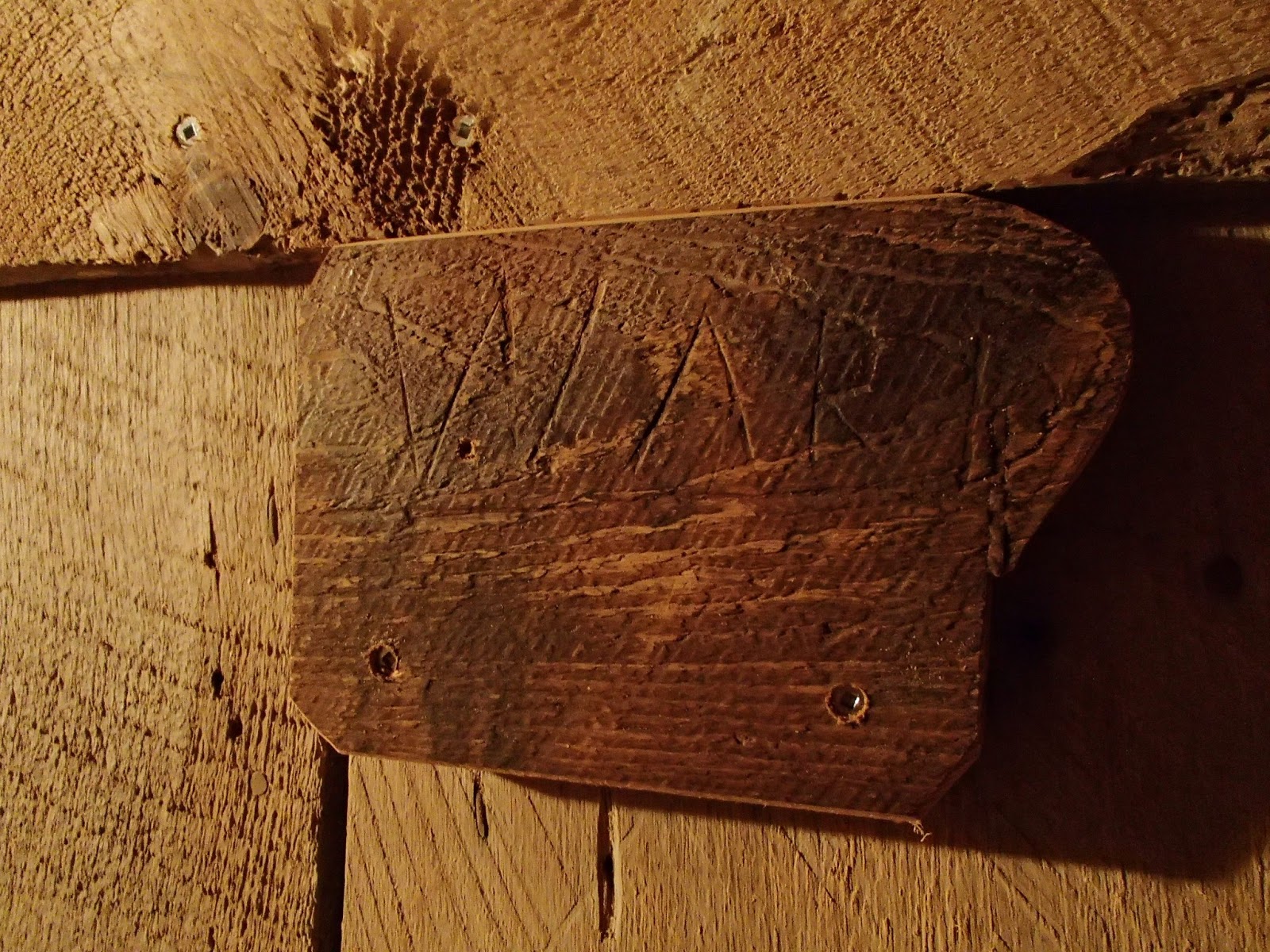
This was a very, very lucky find!
On the farming front things are progressing well. We have been transplanting some old and hardy black currants to new rows. These were "bush-hogged" last year but proved to have very healthy, large and deep roots....so we decided we might as well relocate them.

Transplanting old Black Currant stock with very well established roots
We've even completely transplanted all of our vegetable seedlings.

Our major issue has been weeding. Our nemesis is the Boxelder or Manitoba Maple. Because we refuse to use chemical herbicides, we are spending a significant amount of time pulling back the branches of this very invasive plant....and where we can, we attempt to pull their roots.

One possible solution brought to our attention by our neighbour Debbie is what she called "home-made roundup". Basically this consists of vinegar, salt and dish soap. We did try this on one Boxelder and after one day, the results were impressive. Over the next few weeks, we'll now see if this is effective and if we can proceed to eliminate some of these nasty weeds.

A healthy Boxelder


One day later, following the application
of our  home-made herbicide


We also had the time this week to carry out another foraging experiment. Last year, I had noticed a large amount of stinging nettles on our property. After finding out that these are a very edible and healthy green (very high in iron and protein), I was determined to try them somehow.

Nettles abound on some portions of our fields
So this week, we decided to make a pesto. To do this, we combined our nettle with another "weed": Garlic Mustard. This plant is not native to the area and is highly invasive. So instead of just pulling it wherever we find it, we decided to eat it!

We obviously also have a lot of Garlic Mustard
Using these two plants, greens from our Garlic, Walnuts (which our neighbour provided us last fall), we proceeded to make our pesto. 

Three key ingredients to a good pesto: Garlic greens, Garlic Mustard and Nettles
We blanched the Nettles (this removes their stinging ability), blended them with the Garlic Mustard leaves, our Garlic greens and the Walnuts. We added a touch of Olive oil, some grated Parmesan, salt and pepper to taste.

The result: very satisfying. The sauce took the bright green colour of the Garlic Mustard. It was more "garlicky" than I actually expected. For the whole family, it was quite a pleasant surprise to actually get something that really tastes good from what we had always considered "useless weeds".

A very satisfying bowl of pasta with Garlic Mustard-Nettle Pesto
I will leave you this week with a picture of a tree which is finally flowering: the Tulip Tree. This is a rare sight in Canada since this tree only grows in a rather restricted portion of the country (South shore of Lake Huron and portions of the Niagara Peninsula). A member of the Magnolia family, this is a beautiful plant with large almost tropical leaves. Wherever we find this tree on the property, this is definitely something we aim to preserve.

Our Tulip Trees are blooming

Sunday, May 26, 2013

Farm to Table

To view the latest from Ridge Berry Farm visit our new blog and site!

The past few weeks have been hectic. One reason for this is our decision to open the Ridge Berry Farm Tea Room. Our concept is to use our Tea Room space and kitchen to share our love for local foods - basically a "farm to table" operation.

In order to do this, we have hired a young local chef: Ryan Beck.

Ryan shares our passion for local and organically grown foods. As a result, he has been working to develop a seasonal menu which reflects what our farm, our neighbors and our forest have to offer (Our Tea Room Link).

Ridge Berry Farm Tea Room Chef: Ryan Beck and his catch of Ramps
He and I have already had an opportunity to hunt for Ramps (Wild Garlic)...and I must admit his pickled ramps are amazing (much better than what I have produced to date).

We've also been sourcing some amazing Ontario artisan cheeses. Touring the facilities was a thrill for cheese fanatic Tristan who managed to get a day off the field.

Shep Ysselstein of Gunn's Hill Artisan Cheese...this young man makes amazing cheeses (you  MUST try his Five Brothers cheese).
It's actually been a pleasure to begin working with Ryan. Not only have we had a chance to sample his pickled ramps, but we've had a taste of his excellent jellies and breads.

Chef's Walnut Sourdough bread...what a treat!
With all of this under our belts, we're now committed to open both the Tea Room and Country Market on June 7th. This will make for an exciting (and very busy) summer!

In the meantime, our foraging activities continue to surprise us. This week, we discovered the May Apple.

This plant covers shady groves in our Carolinian forest, often close to wet lands. Long used as a medicinal plant by the Native Americans, it is also highly toxic. In fact, it is an important wild crop for the pharmaceutical industry which uses it in cancer treatment (primarily for chemotherapy).

The May Apple (Podophyllum Peltatum)
Our interest in this plant however extends beyond its pharmaceutical use. Under the umbrella-like leaves is a singular large flower which turns into an "apple". When green, this apple is also toxic. When ripe however, this is a perfectly edible fruit which was enjoyed by both Native Americans and early settlers.

The May Apple flower which will transform into an "apple"
Now that we know we have a large quantity of May Apples on the property, we will be sure to follow its development and give it a try when it ripens.

This week was also an opportunity to follow up on our initial foraging experiments with cattails. This Winter, we used the rhizomes to make flour. This Spring, it was time to harvest Cossack Asparagus. These are the young green shoots of the cattail.

Cossack Asparagus (or young Cattail shoots)
In order to have tender shoots, we picked the youngest growth (those are the shorter and smaller diameter shoots). Like conventional asparagus, the larger shoots quickly become "stringy" or "woody".

To prepare, we just cut back the shoots to their white parts (some 6 to 8 inches) and pealed back any green or stringy layers.

The shoots can be eaten raw. They are reminiscent of cucumber. However, they do take on an additional dimension when cooked.

Our "wild" harvest: Asparagus, Spring Onions and Cossack Asparagus (Cattail shoots)
We decided to pick some of our wild asparagus and Spring onions and prepare a plate that would allow us to compare the Cossack Asparagus (cattail shoots) to the conventional Asparagus.

Using some butter, we simply pan fried the cattail shoots, the asparagus, the Spring onions and some of our Garlic Scapes. We served these with farm fresh scrambled eggs.

Scrambled farm eggs with Asparagus and Cattail Shoots
This actually made for a very good meal!

So what about the Cossack Asparagus? Well, it is actually very good. It has a mild flavour and the texture is very similar to Asparagus. It also reminds me a bit of Palm Hearts. The taste is not as intense as Asparagus, so it actually complemented the eggs very well and really absorbed the flavour of our butter.

Will we do it again? Absolutely; this is good food. We can now hardly wait for the next experiment: green cattails heads.

As we wait for our crops to grow, we've continued to plant and transplant our vegetables. It is hard to believe but our Zucchini is already flowering. I also cannot believe the size of our Brussel Sprouts and our Garlic.
Our first Zucchini flower.
From tiny seeds...a lush bed of Brussel Sprouts.
Even the Garlic is exceeding our expectations
Given how rapidly things are growing, this is also the point where we realize we've created an amazing salad bar for all sorts of wild creatures that inhabit the farm.

We'll try to defend our plot as best we can....but we are prepared to see some major losses over time. Let's hope they just leave enough for us.

Work on the home renovations continue and this week we will close this week with a new discovery.

The entrance to the cellar which we discovered in the west wing (next to an old foundation which preceded the house) have been worked on. We had to add a step since we were now constructing a floor above the old foundation.

The existing steps were in 2 parts: concrete and a rather thick slab of wood on the top surface. Our contractors decided to re-use the landing which had some damage to the edge, to re-create a step in the same fashion.

The old cellar stairs (Note the thick wood slabs on the upper surface)
The surprise came when this piece was cut. From the cutting we could not only identify the tree (White Oak), but as well the age of the tree.

We're still counting rings....but this amazing piece of wood came from an ancient tree which would have been well over two centuries old!

A cross-section of the landing: a very ancient White Oak!
Needless to say we will now treasure these stairs....we will also keep and preserve the cutting as a discussion piece.

Sunday, May 19, 2013

The Last Frost

To view the latest from Ridge Berry Farm visit our new blog and site!

We knew we were taking a risk when we transplanted some of our vegetables earlier this month. That risk was frost....and this week started with our greatest fear: two nights of below zero temperatures.

We were caught off guard on the first night. After assessing the damage the next morning, we decided things were not so bad. We had taken in everything we could and in our raised beds the only casualty seemed to have been our heritage wax beans.

On the second night, we decided to protect as much as possible. We improvised by putting together some makeshift greenhouses. In the barn, we had found some plastic vapour barrier. We propped it up using our trellises and covered the most delicate plants (basically everything but the cabbage varieties).

Makeshift "greenhouse" to protect against the last frost
We were not certain this would work but in the end things seem to have gone quite well.

In fact, we do not seem to have been affected...with one exception: our kiwis. We were horrified to see all of our Kiwi leaves turn black as if they had suffered a major burn. At first we were extremely worried. Last year, they had survived a very early Spring and late frost. This year, I was not so sure.

After a few days though, we were somewhat comforted to see new leaves spring out and actually new flower buds. Things may still turn out very well.

Frost-damaged Kiwi vine, quickly on the path to recovery
On the planting front, Tristan and I finished all of our raspberry rows. By dividing the planting process into separate tasks, we were able to bring our timing from 3 hours a row, to one and a half hours and eventually down to 35 minutes.

The front portion of the farming is almost complete and looking rather good. Our skills are slowly improving.

Our rows are getting straighter and our efficiency is improving
Amazingly, our red and black currants, planted just a couple of weeks ago, look like they will flower and fruit (like our Gooseberries). All of of our stock so far has taken to our soil very well. The more we see things like this, the  more we are motivated.

Red Currants: planted as "little sticks" but already showing signs of budding
Having planted all of our stock, we decided to begin work on the side of the barn. Here we were determined to plant Lavender. When I think Lavender, I usually think of the Cote D'Azure in the South of France. However some folks in the Niagara Peninsula have made it a viable local agricultural crop.

Since some of the items we will carry in our store include Niagara based Lavender products, we wanted to showcase this plant close to the country market. For this purpose, we obtained from our friends at Niagara Essential Oils a local variety of Lavender which is effectively a cross between English and French Lavender (it has the scent of French Lavender but is easier to care for and smaller like its English counterpart).

So Tristan and I created a  new raised bed which was eventually covered with gravel. The stone will reflect the sun and provide a hotter climate for the plants.

Planting Lavender...and making it look relaxing!
Now we wait....hopefully over time these 40 plants will mature to beautiful blooming bushes.

This week, we also expanded our vegetable garden toward the Beaver pond. With our potatoes chitted (or pre-sprouted), it was time to create some rows and plant them. I guess we'll see how these turn out later in the year.

Our "chitted" potatoes
The expansion to the vegetable garden: rows of potatoes being tilled
This week, our foraging experience came courtesy of Roger, our neighbour and postmaster. He brought to us a Dryad Saddle mushroom which he had found in the forest. This was an edible find he suggested we look into. He told us where he found them, but try as we might, we simply could not find them.

Returning home a little deflated, we actually discovered some on an old fallen log across our creek leading to the Beaver pond.

These are beautiful mushrooms and given their look, I prefer their other name: the Pheasant Back Saddle mushroom; the pattern on the top is very reminiscent of the feather pattern on a pheasant.

The Pheasant Back (or Dryad) Saddle Mushroom
These mushrooms can grow to well over 12 inches and the ones we found were certainly in that range. When they are large, they are not as tender as younger versions of this variety. In any case, we decided to give them a try.

I sliced them and fried them in butter. We then added caramelized onions and dried herbs. I even tossed in some of our Garlic Scapes. A touch of salt and pepper and some heavy cream provided a decadent topping for an open faced baguette sandwich....what a find!

A great way to enjoy the Pheasant Back Saddle mushroom
With the many trees blossoming, I decided to try to create an inventory of useful trees (for nuts, tapping or fruits).

Since we had used the bush hog to clear some of the inaccessible land last fall, we quickly discovered certain things we had not noticed before. One of these great finds was two rows of Juneberries (Amelanchiers or Saskatoon Berries). I had actually planned to plant some...now, we may not have to.

The last Spring time blooms of the Juneberry
We also discovered quite a few strawberries. These are not wild, but seem to be remnants of the old 10 acres of "pick your own" that used to be on the farm.

These surviving Strawberry plants can be found just about everywhere on the property
These along with the many old raspberry and wild blackberry canes will definitely keep us busy come harvesting season.

I will leave you this week with just a few Spring time photos of some the flowering trees I have been working to identify. The list is long. There is so much, I fear it will be quite a while before we can really catalogue all of the little treasures on this land.

Flowering Dogwood
Black Walnut Blossoms
Still working on this one! (Cottonwood?)
Ash (still need to pinpoint variety)

Sassafras Blossoms
Red Oak Blossoms