Sunday, June 22, 2014

Summer has Finally Arrived

To view the latest from Ridge Berry Farm visit our new blog and site!

It has been a real pleasure working on the farm this week. Although the rains have provided a great opportunity for mosquitoes and black flies to multiply, the sunny days have been truly magnificent.

Our first priority has been to tackle our Growing Dome aquaponic system issue: Algae. Those following this major experiment will recall that the presence of Algae has been stunting the growth of our plants. Furthermore while attempting to use a shade cloth over our main water tank we managed to inadvertently kill our fish.

The ultimate solution arrived in the post this week: Humic Acid. Humic Acid is not as acidic as the name would imply. It is the basic component of humic substances which are the organic components of soil, peat and coal. It is usually used as a soil conditioner and mild fertilizer.

A few years worth of Hunic Acid
Our main interest in this substance is not necessarily its benefit to plants nor the fact that it is inoffensive to fish, but rather the fact that just a bit of this powder will turn large volumes of water jet black. So, we first diluted this powder into a bucket of our Algae contaminated water.

Adding a few ounces of Humic Acid to our Algae prone aquaponic water

The result is an inky black swill
We added this to our tank and it almost seemed like we created an oil slick.


Adding the Humic Acid solution to the main tank
You may wonder why do this? The reason is simple. Without the ability of light rays to penetrate the water, this solution should completely eliminate the Algae. In fact, in the matter of two days, it has completely disappeared.

Although our water is still black, our tank is now healthy and void of Algae
This has had an impact on our plants which seem to be doing much better....now and once again, we have to get back to seeding the tank with fish.

Elsewhere on the farm, berries are ripening and flowers are blooming everywhere. Even our Kiwis on their new trellises are showing signs of a very abundant crop. 

We have never seen so many Kiwi flowers concentrated in one area

One of the more beautiful blooms is a new plant we introduced to the raised beds this year: Borage. The flower is bright blue and star shaped.

Flowering Borage
Borage is new to us and was recommended by Chef as one of the herbs on his rather long "wish list". Both the leaves and flower of Borage are edible. The taste of the flower is not what we expected. It is certainly not as sweet as many of the other flowers we have been using. In fact, Chef pointed it out best when he likened the taste to Oysters (without the sea salt).

Borage is used in many parts of Europe, but we had actually not seen or tasted it before.

So you may wonder what we actually do with this amazing plant. In the Tea Room, Chef has prepared this week a beautiful delicacy: Borage and Nettle Raviolone.

Borage and Nettle Raviolone in a butter sauce with Garlic Scapes.
Meanwhile on the farm, we also started an interesting experiment...one for which I think a lot of local farmers will consider us "crazy". It all has to do with the Apple trees.

We're tired of having insect infected and misshapen Apples. We also do not want to use harsh insecticides (including BT Toxin which is still acceptable to Organic certification).

So we decided to try a concept which originated in Japan. We selected a few good new Apples from our Pippin trees and covered them with nylon "footies" (the disposable nylon socks used to try on shoes).

A healthy small Pippin Apple...
...now protected by a nylon "footie".
We kept on the same branch some "control" Apples to see the difference in the Fall. We're hoping this will work, although we have to admit it does take quite a bit of time and unlike in Japan, we're not going to be able to sell any of these at $10 a piece.

What we are hoping for is an unblemished Apple that we can positively identify. There are quite a few varieties of Pippin and since these trees are quite old we are considering propagating them.

On the foraging front, we decided to tackle one of the fiercest "weed": the Wild Rose. The thorns of the Wild Rose have been more than often a very painful experience for us. But as we clear the land, we have actually been keeping a few bushes alive in some strategic locations.

This time of year, the Wild Rose is blooming and releasing a wonderful fragrance. You can usually smell them well before you see the bush. We noticed this last Spring.

The Wild Roses on the farm have white petals and a yellow centre

This year, we decided to put some of these plants to good use. We made a Wild Rose Petal syrup.

Amongst swarms of mosquitoes, we trimmed the end of the branches carrying these blooms and collected them in the back of our John Deere.

Collecting Wild Rose blooms
 We then took them to a safer site (away from the mosquitoes) to process them. Basically we pulled the buds and removed all of the petals which were ready to fall from the stem.

Petals and blooms ready for processing
The next steps involved making a light sugar syrup (1 part sugar, 2 parts water). The volume of syrup was identical to the volume of petals. This syrup was poured over the blooms and we let it steep over night.

The next day we filtered the petals twice. The second time through a fine paper coffee filter. The result was a wonderful rose flavoured syrup, ideal for deserts or as a tea sweetener.

Wild Rose Petal Syrup
There is a sediment to this syrup because we used some complete blooms. It proved difficult to completely filter the pollen. Either we will have to improve our filtering next time or we will have to spend the time picking the petals from all blooms.

Finally, the manor itself is starting to look quite different. This week, we started work on the front landscaping. The house really looks like a construction site, but not for long!

Back to a construction site....work on the landscaping has begun.
We'll end this week, by reminding everyone that next Saturday (the 28th) we are hosting the 2014 Pelham Heritage Tea Party. People are urged to come in costume for this annual event. The 10$ tickets are available at the Pelham Town Hall or at Tea Room.


Sunday, June 15, 2014

Tourism Season Begins

To view the latest from Ridge Berry Farm visit our new blog and site!

With the warm weather, tourists are now returning to the Niagara Peninsula. This week at the farm, we had to close the restaurant for one afternoon to welcome a bus load of tourists originally from Taiwan. For us, it was an amazing pleasure to welcome them to Pelham to get a taste of the region; Niagara is so much more than the Falls, the Casinos and the wineries.

Our first tour bus of the season....luckily we have the parking space.

Their key interest was to learn about history and local foods ...right up our alley. The Manor has proven to offer a fascinating backdrop to discuss the Victorian past of the area, while we were also able to educate these avid learners about the health benefits of many wild and local plants, as well as our berries.

In general, we had a great time and certainly hope they did as well.

What we did not expect is that they cleaned us out of some of our inventory. After doing a demo on how to use cordials (fruit syrups), our shelves were completely cleared! We now have to ship some orders and need to rebuild our stock.

Empty shelves....we will need to increase production
Elsewhere on the farm, this week was rather tragic. We lost our fish in the growing dome....again! And this time, it was purely our fault.

As for most start-up aquaponic environments, we have been tackling an algae problem. We have so much algae in our system that these small plants have been absorbing the nutrients in the water to the detriment of our hydroponic tables. As a result, our plants are suffering from stunted growth.

Our preliminary solution was to shade the large water tank in order to minimize the amount of sun available for algae growth. This is where things went wrong. In doing so, we displaced a water pipe feeding the aeration pump. We could not tell the pump was off because of the shade cloth and because of the noise of water flowing to the hydroponic tables for which the pump was still working.

Our shade cloth over the main water tank
The bottom line, our fish were asphyxiated and I just can't sufficiently express our disappointment.

In any case, we've learned a valuable lesson and we're definitely going to continue our work....we feel so very close to a permanent and stable solution.

On another front, we still have a lot of space well exposed to the sun in the Growing Dome. So we've decided to experiment with another hydroponic technique requiring no energy. We set up two experimental tables below those used for aquaponics. The concept we implemented here is based on the work of Dr. Kratky from the University of Hawaii.

Conventional hydroponics require some form of energy (electricity) to pump water through bubbling stones. This helps oxygenate the water which is essential to good and healthy root development. For the aquaponic tables this is achieved by the aeration pump (when we don't mess with it) and the water flow from table to table.

The Kratky method is actually very simple and overcomes the need for any pump. The hydroponic tables are filled with water and nutrients. The plants are then mounted atop this solution. As they consume water and nutrients, the water level descends. The roots develop to reach toward the nutrient solution while a larger segment of the root becomes exposed to air (ie. oxygen).

In our case, we first seeded our plants in Perlite. This allows the plant to develop a good root while making it relatively easy to transplant once we're ready to transfer them to a hydroponic table.

Cucumber seedling removed from its Perlite bed
Once they had developed a reasonable root length, we placed them in small plastic baskets extending the root out of the basket as much as we could. The plants are again held upright with Perlite.

The same seedling ready for its new hydroponic bed
We mounted the baskets on insulation boards in a manner similar to our aquaponic tables. In this case however, the boards are not used as floating rafts, but rather as lids to the hydroponic tables, basically fixing the height of the plant above the water and nutrient solutions. As nutrients, we used liquid organically derived nitrogen, potassium and phosphorous....and now we wait.

Final Kratky installation
We actually thought that this might be a good idea for the aquaponic tables as well. Basically, using the mounting platforms of insulation not only provides more oxygen to the roots, but also prevents sunlight from reaching the water (another way to control algae). In this case however, the nutrients would come from the fish (once we've got that resolved) and the water levels would be maintained.

Wax bean combining the Kratky method with our aquaponic tables
So far, our beans seem to love the concept. Our major concern now is that we may not be able to mix plant varieties in a single bed, since some root systems might develop faster than others (part of our current experiment).

Elsewhere on the farm, the berries are really coming along. The Raspberries are flowering while the Gooseberries are ripening, as are the Currants. The latter are proving prolific and we hope to be able to produce some amazing Black Currant jam this summer. We'll probably also work on a cordial (syrup) and we definitely want to experiment with a wine.

The Black Currants are prolific
We were also quite surprised to find that our small Haskaps, planted earlier this year, have already produced some berries. This was a great chance to try this fruit.

Haskap berries....enough to get a taste of things to come
The Haskap taste turns out to be very similar to Blueberry, perhaps a little more tart. The texture of the berry is amazing. The seeds are like Kiwi seeds and the skin is very fragile so the berry simply melts in your mouth. We have some great hopes for this berry since it will likely make some superb jam, cordials and pies.

Finally, the farm is home to a variety of wildlife and this week has been a bit frustrating.

The deer have become a lot more brazen this year. We have found them munching the tip of our apple tree branches just behind our Tea Room. They've also munched on a few of our fruiting bushes. Luckily, our Paw Paw have survived and they seem a lot more vibrant than when we planted them last fall.

Evidence of munching Deer just behind the Tea Room
Another visitor this week was a large Snapping Turtle once again in our backyard to lay eggs. This happened last year close to our raised beds. With the many ponds and swamps on the property I guess we can expect this to become an annual event. And once again, we'll probably have to save some of the baby turtles from going into our parking lot or even crossing the road.

Once again our backyard will become a turtle nursery

Sunday, June 8, 2014

Clearing and Discovering

To view the latest from Ridge Berry Farm visit our new blog and site!

Now that Spring showers and the warm weather have finally arrived, we find ourselves spending most of our time weeding and clearing land. Since we refuse to use herbicides, weeding is a never ending story. By the time we finish all of our rows we need to start again. Somewhere down the line we'll have to find new techniques.

With the ever present Wild Grape, Wild Rose and Virginia Creeper, clearing is no less a challenge but it is exciting since we always seem to discover and find new useful plants.

This week we began clearing the west side of our creek, starting with the an area next to the Kiwis. It turns out that the Kiwis themselves have become quite invasive.

We managed to free up a rather large and beautiful Birch. Our prized producer of sap for Birch syrup production.

Freeing a magnificent old Birch
We even managed to free a Tulip tree and a Pin Cherry tree which the Kiwis had almost completely taken over. The vines were a couple of inches in diameter and had traveled as much as 50 feet to the top of the canopy.

A canopy covered with Kiwi vines
So far on the other side of the creek, we managed to find a patch of Elderberries and a sad looking Mulberry tree. In fact it was a surprise to find that not only was the Mulberry still alive, but it was fruiting. Hopefully some sun and proper pruning will bring this tree back to production.

A sad Mulberry finally seeing the light of day
In fact, this Mulberry reminded us to check on the two trees we pruned earlier this year. We were not certain of our approach, however whatever we did seems to be paying off. All branches are loaded with fruit and the fruit does seem to be larger than last year.

Branches loaded with Mulberries
Elsewhere on the farm, other berries are starting to take form and ripening. The first to be picked will likely be the Gooseberries. This is a red variety so we're now patiently waiting for them to ripen.

Our Gooseberries are slowly ripening
We'll close this week with another foraging notice: the Black Locust is flowering. These fragrant flowers will not last long, perhaps 10 days. They are extremely useful for the production of honey and are in fact the source of pollen for Acacia monofloral honey in France.

These trees are pervasive in this region yet few are aware that the flowers of this tree are edible. Not only are they edible but also quite delicious. They are sweet with a cucumber-like crunch. As a result, Chef tends to use them as a garnish.

In Europe, they are coated in batter and deep fried; this is also the case for Elderberry flowers which are now starting to form.

The edible Black Locust flowers

Sunday, June 1, 2014

Seeding the Growing Dome

To view the latest from Ridge Berry Farm visit our new blog and site!

Since we have not reported much on the Growing Dome recently, we thought this would be a good time to provide an update on all of the things that have been accomplished so far....and in particular our "seeding" of the dome with both plants and fish.

First, it's important to note the purpose of the dome:

1. to provide a greenhouse environment for our seedlings,
2. to provide a year long environment for growing fruits and vegetables, and
3. to establish a closed loop ecosystem using the concepts of Aquaponics.

In addressing the first point, the dome succeeded exceedingly well. Of 50 varieties of plants, all germinated successfully and many achieved the flowering stage well before expectations.

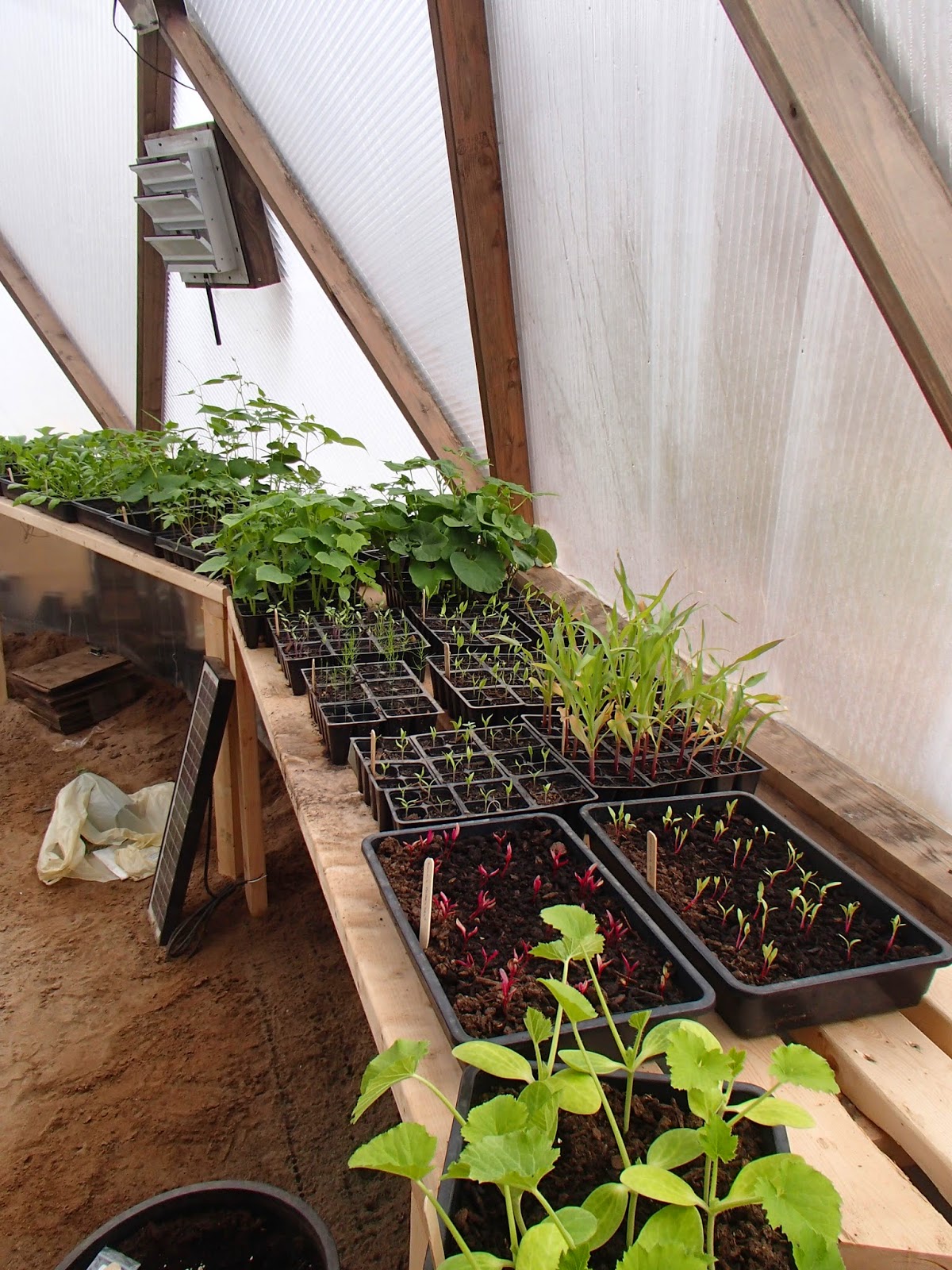
By the end of April, all of our seedlings were ready for transplant
By the time we were ready to transplant our seedlings (mid-May), the transfer proved to be a shock for some of the plants. We lost all our Cucumbers while a majority of the Scarlet Runners were simply not pleased to be taken out of the dome. We can start over with the Cucumbers, but we're quite fortunate to have kept a couple of Scarlet Runners in the dome (in fact these were transferred to the hydroponic tables).

We've not yet had a full year of operation to demonstrate the second objective. However, our Strawberry plant and our Sage have done extremely well. The Sage has already flowered and gone into seed, while we've been munching on strawberries for a month now. The outlook is very promising as we experiment with more plants and different growing conditions (both soil and hydroponic beds).

Our Sage flowered in April in its hydroponic bed.
The last item on our list of objectives has proven a bit more difficult.

For the plants, we have found that seedlings grown in soil can be readily transferred to the hydroponic beds. Some plants (like the Scarlet Runner) have rapidly developed massive root systems.

We're now experimenting with Peppers, Tomatoes and Melons.

One week into the hydroponic bed and the Scarlet Runner roots begin to grow wild

Starting seedlings in the hydroponic beds has proven a bit more difficult. We have used rock wool pellets as the growing medium. With these, we discovered that our lettuce (Brune d'Hiver) could not develop properly. For some reason the roots could not penetrate the rock wool and the small leaves withered in the hot and humid environment of the dome.

On the other hand, Swiss Chard and Kale seem to be working out so far.

On the other side of the equation, the fish in the large water tank have proven difficult as well. Regular blog readers will know that we lost all of our Tilapia due to cold water temperatures.

We decided in the meantime to seed the tank with some of the fish from our ponds. These turned out to be 3 species: Fathead Minnows, Sunfish (or Rock Bass) fingerlings, and one we simply could not identify.

One of the Fathead Minnows we used to "seed" the water tank
The minnows survived quite well and seemed pleased to munch on fish pellets. However, we had greater aspirations: a good eating fish.

Since we know water temperatures will get quite cold in winter, we decided that a sustainable local species might be better suited to the job. We settled on the Largemouth Bass. We managed to acquire some of these fish from a fish farm close to Windsor, Ontario.

A Largemouth Bass ready to be introduced to its new home
So far, the bass has been working out quite well. We do however have another problem on hand: Algae bloom. This is of no great concern in the water tank, it is however "gumming up" our hydroponic tables and we have no idea what this might do to our plant roots, although technically more plants in the hydroponic beds should reduce the nutrients available for Algae growth.

Peppers and Tomatoes growing in a thick "soup" of Algae
Aside from readying more plants for our beds, we're now assessing other natural ways to control this Algae. We have two options: filtering and an Algae feeding fish.

We've discounted filtering so far because of our limitations on energy consumption. Proper filtering would require much greater water pressures than we can handle now with our small bilge pumps and solar arrays.

We may now try some Plecostomus as long as the fish are of similar size to the Bass (note: our minnows have disappeared since we introduced the Bass to the water tank).

All in all, we still feel things are progressing and we're well on our way to achieving our objectives.

We'll close this week with the foraging find of the year: Morrells. Everyone in the area should be on the look out for these superb mushrooms.

An amazing find! Delicious Morrells

I wish I could say we found these, but we have to give full credit to Calvin who has now picked almost 2 pounds of Morells. Calvin is Chef's new help in the Tea Room kitchen and with this find, we can now call him "master forager" :)

Sunday, May 25, 2014

Fathers' Day Celebration

To view the latest from Ridge Berry Farm visit our new blog and site!

With the Tea Room open and the operation in "full swing", we had such a great Mothers' Day, we decided to do something special for Fathers' Day on June 15th.


We're now taking reservations for Chef's especially conceived "manly" menu, a choice of 2:

1. A delicious 8 oz. Kent Heritage natural beef patty, pan seared on a toasted challah bun, topped with local lettuce, sweet madras mayonnaise, house smoked bacon, tomato relish and a fried egg. Served with a side of house made potato chips.

2. A trio tasting of sliders, including a Ling cod tempura with tartar sauce, a Beef patty with our in house tomato relish, and a Portobello slider topped with wild pesto. Served with a side of house made potato salad.

Meanwhile on the farm, this week has all revolved around bees!

We have wanted to start a few of our own colonies. We need the pollinators and can always use the honey. However, we have so many projects on hand, we decided to take a "short cut" this year. We are "renting" our farm to a bee keeper, in return for honey.

So this week, we took delivery of 176 hives.

A major bee delivery
We have some great site for bees: lots of blooms, shade and water. Where the colonies were installed is actually looking like a suburban condo community for bees.

Our bee condo community
It will not be long before we can sell Ridge Berry honey.

Of course, our need for honey is also based on our wine making aspirations. Now that the weather is clear, we decided to return to our fruit wine making experiments. We stopped for the winter when we discovered how sensitive the process is to temperature.

Now we can start again with our new 50 liter fermentor. Scaling up is proving somewhat difficult for lack of space. In fact, we had to set-up our new operation in the corner of our house kitchen.

Our new and assembled fermentor "tucked away" in the kitchen corner
We did not realize that scaling up to 50 litres means a variety of logistical details (like handling the pasteurization of the honey water combination and the transfer of liquids from one container to another). We had to improvise and with a good siphoning hose managed to work everything out, although ultimately we will need to arrange for some proper pumps.

The height of our stove and a makeshift stand for the fermenter helped siphoning from one container to the other
A feature of this fermenter is a lower plate which acts as a filter. This means that we can directly add the fruits to our mead and the resulting must is easy to filter.

So for our first batch, we decided to make a Raspberry wine. Our recipe roughly calls for 1 kg if honey for every 2 litres of water. To this we add about the same amount of fruit as honey.

Frozen Raspberries ready for honey, water and yeast
Now, it's a waiting game!

For those following our foraging activities, this week it was time to pick the Garlic Mustard and the stinging Nettles. Both are young and tender, ready for the picking.

We have no shortage of Garlic Mustard

The young Nettle is also ready for picking
We have experimented with these plants last year and found them to be a great food. This year, Chef has decided to use them in a Wild Pesto mix (and part of our Fathers' Day menu).

It is amazing what you can do by blending Olive Oil with Nettles, Garlic Mustard, Ramps and Walnuts (a variation on Italy's "Pesto di Ortica").

Chef's Wild Pesto
We'll close this week by saying that things are not all work on the farm. In fact, one of our neighbours dropped by with a "mean" quad ATV. It was not long before Tristan was offering rides...of course he wants one of these now.

A real break from farm work.

Sunday, May 18, 2014

Black Raspberries and Cossack Asparagus

To view the latest from Ridge Berry Farm visit our new blog and site!

Last year we discovered on the farm the Black Raspberry. These grow wild on the edge of the Carolinian forest. We never even knew that such a thing existed. It turns out however that they are highly prized for their anti-cancer or cancer fighting properties.

The wild Black Raspberry 

We took advantage of this find. We picked some, sold them, and made some jams. The taste of these berries is unlike any conventional raspberry. The jam they make is simply superb. They were in fact so popular, we decided this year to add to our crop by extending our plot with some new stock.

So this week we took shipment of some 350 canes and began planting.

Planting a new crop: the Black Raspberry
Although the weather has been surprisingly cold for this time of year, we've been rather surprised at how quickly some of our other berries have started blooming.

The Black Currant look like they will yield a significant amount of fruit. This is also where we discovered we planted things much too close together (transplanting will be necessary ). But we also have a neat concept for trellising these plants we hope to implement next Spring.

The Black Currants are in full bloom
The Red Gooseberries have even progressed further. Small fruits are already developing on many of our plants.

The Red Gooseberry fruit is already developing
Even the Haskaps, which we planted just a few weeks ago, have started to bloom. We actually now hope to harvest some of these new berries this year.

The Haskap bloom
In fact, a lot of things have started to bloom and plants in the Growing Dome seem to be well ahead of others. This included our beans (Beurre de Rocquencourt and Scarlet Runners) and even our melons.

This meant it was time to begin transplanting things to our raised beds. Even though the temperature difference between the dome and beds was significant, the incredible amount of rain we faced this week helped in the transition.

Transplanting to our raised beds
Although, we did create a lot of raised bed space this year, it seems we may again run short of space. We went a little crazy in ordering our seeds and with some 50 varieties of plants all successfully started in the dome, we are now looking at every corner of the farm for space to transplant.

While this has been going on, we also continue to forage. This week it was time to pick the "Cossak Asparagus". We discovered this last Spring, but picked them a little too late (the exterior was overly stringy). This year, we picked them just in time.

For those not familiar with the Cossack Asparagus, we're actually talking about the Cattail shoots.

Cattail shoots (aka. Cossack Asparagus) ready for the picking
The shoots can be pulled almost as you would pull on a long blade of grass to release the white base of the leaf. This part of the plant is not only edible but quite good. It can be eaten raw (like a Cucumber) or cooked (like a conventional Asparagus). The texture of this food is similar to hearts of Palm.

Cattail shoots, ready for eating or processing
We're now trying to pickle these shoots and hope to make them available at our Tea Room restaurant and market.

We'll end this week's blog with an update on the old manor's renovation. The interior is now completed and it is now time to complete the exterior.

The major effort has been the landscaping on the back ridge (behind the house). Our concept has been to turn the ridge into terraces; terraces we can use for growing herbs and vegetables (more space for the plants we started in the dome).

Little did we know how massive a project this would become.

The ridge in the back of the manor is slowly being transformed into growing terraces
The outside of the manor is also undergoing a "face lift". Now that it has been restored, the wood trimming of the house has been repainted in a wheat yellow colour (instead of its original bright white). This colour is more in line with the Victorian times and really shows off the details in the wood trim.

The newly painted manor
All that is left to accomplish is the iron work. This was taken down to be completely redone since it was falling apart.

We'll conclude by wishing all our Ontario friends a great May 2-4 weekend and our US friends a wonderful Memorial Day weekend.