Sunday, May 25, 2014

Fathers' Day Celebration

To view the latest from Ridge Berry Farm visit our new blog and site!

With the Tea Room open and the operation in "full swing", we had such a great Mothers' Day, we decided to do something special for Fathers' Day on June 15th.


We're now taking reservations for Chef's especially conceived "manly" menu, a choice of 2:

1. A delicious 8 oz. Kent Heritage natural beef patty, pan seared on a toasted challah bun, topped with local lettuce, sweet madras mayonnaise, house smoked bacon, tomato relish and a fried egg. Served with a side of house made potato chips.

2. A trio tasting of sliders, including a Ling cod tempura with tartar sauce, a Beef patty with our in house tomato relish, and a Portobello slider topped with wild pesto. Served with a side of house made potato salad.

Meanwhile on the farm, this week has all revolved around bees!

We have wanted to start a few of our own colonies. We need the pollinators and can always use the honey. However, we have so many projects on hand, we decided to take a "short cut" this year. We are "renting" our farm to a bee keeper, in return for honey.

So this week, we took delivery of 176 hives.

A major bee delivery
We have some great site for bees: lots of blooms, shade and water. Where the colonies were installed is actually looking like a suburban condo community for bees.

Our bee condo community
It will not be long before we can sell Ridge Berry honey.

Of course, our need for honey is also based on our wine making aspirations. Now that the weather is clear, we decided to return to our fruit wine making experiments. We stopped for the winter when we discovered how sensitive the process is to temperature.

Now we can start again with our new 50 liter fermentor. Scaling up is proving somewhat difficult for lack of space. In fact, we had to set-up our new operation in the corner of our house kitchen.

Our new and assembled fermentor "tucked away" in the kitchen corner
We did not realize that scaling up to 50 litres means a variety of logistical details (like handling the pasteurization of the honey water combination and the transfer of liquids from one container to another). We had to improvise and with a good siphoning hose managed to work everything out, although ultimately we will need to arrange for some proper pumps.

The height of our stove and a makeshift stand for the fermenter helped siphoning from one container to the other
A feature of this fermenter is a lower plate which acts as a filter. This means that we can directly add the fruits to our mead and the resulting must is easy to filter.

So for our first batch, we decided to make a Raspberry wine. Our recipe roughly calls for 1 kg if honey for every 2 litres of water. To this we add about the same amount of fruit as honey.

Frozen Raspberries ready for honey, water and yeast
Now, it's a waiting game!

For those following our foraging activities, this week it was time to pick the Garlic Mustard and the stinging Nettles. Both are young and tender, ready for the picking.

We have no shortage of Garlic Mustard

The young Nettle is also ready for picking
We have experimented with these plants last year and found them to be a great food. This year, Chef has decided to use them in a Wild Pesto mix (and part of our Fathers' Day menu).

It is amazing what you can do by blending Olive Oil with Nettles, Garlic Mustard, Ramps and Walnuts (a variation on Italy's "Pesto di Ortica").

Chef's Wild Pesto
We'll close this week by saying that things are not all work on the farm. In fact, one of our neighbours dropped by with a "mean" quad ATV. It was not long before Tristan was offering rides...of course he wants one of these now.

A real break from farm work.

Sunday, May 18, 2014

Black Raspberries and Cossack Asparagus

To view the latest from Ridge Berry Farm visit our new blog and site!

Last year we discovered on the farm the Black Raspberry. These grow wild on the edge of the Carolinian forest. We never even knew that such a thing existed. It turns out however that they are highly prized for their anti-cancer or cancer fighting properties.

The wild Black Raspberry 

We took advantage of this find. We picked some, sold them, and made some jams. The taste of these berries is unlike any conventional raspberry. The jam they make is simply superb. They were in fact so popular, we decided this year to add to our crop by extending our plot with some new stock.

So this week we took shipment of some 350 canes and began planting.

Planting a new crop: the Black Raspberry
Although the weather has been surprisingly cold for this time of year, we've been rather surprised at how quickly some of our other berries have started blooming.

The Black Currant look like they will yield a significant amount of fruit. This is also where we discovered we planted things much too close together (transplanting will be necessary ). But we also have a neat concept for trellising these plants we hope to implement next Spring.

The Black Currants are in full bloom
The Red Gooseberries have even progressed further. Small fruits are already developing on many of our plants.

The Red Gooseberry fruit is already developing
Even the Haskaps, which we planted just a few weeks ago, have started to bloom. We actually now hope to harvest some of these new berries this year.

The Haskap bloom
In fact, a lot of things have started to bloom and plants in the Growing Dome seem to be well ahead of others. This included our beans (Beurre de Rocquencourt and Scarlet Runners) and even our melons.

This meant it was time to begin transplanting things to our raised beds. Even though the temperature difference between the dome and beds was significant, the incredible amount of rain we faced this week helped in the transition.

Transplanting to our raised beds
Although, we did create a lot of raised bed space this year, it seems we may again run short of space. We went a little crazy in ordering our seeds and with some 50 varieties of plants all successfully started in the dome, we are now looking at every corner of the farm for space to transplant.

While this has been going on, we also continue to forage. This week it was time to pick the "Cossak Asparagus". We discovered this last Spring, but picked them a little too late (the exterior was overly stringy). This year, we picked them just in time.

For those not familiar with the Cossack Asparagus, we're actually talking about the Cattail shoots.

Cattail shoots (aka. Cossack Asparagus) ready for the picking
The shoots can be pulled almost as you would pull on a long blade of grass to release the white base of the leaf. This part of the plant is not only edible but quite good. It can be eaten raw (like a Cucumber) or cooked (like a conventional Asparagus). The texture of this food is similar to hearts of Palm.

Cattail shoots, ready for eating or processing
We're now trying to pickle these shoots and hope to make them available at our Tea Room restaurant and market.

We'll end this week's blog with an update on the old manor's renovation. The interior is now completed and it is now time to complete the exterior.

The major effort has been the landscaping on the back ridge (behind the house). Our concept has been to turn the ridge into terraces; terraces we can use for growing herbs and vegetables (more space for the plants we started in the dome).

Little did we know how massive a project this would become.

The ridge in the back of the manor is slowly being transformed into growing terraces
The outside of the manor is also undergoing a "face lift". Now that it has been restored, the wood trimming of the house has been repainted in a wheat yellow colour (instead of its original bright white). This colour is more in line with the Victorian times and really shows off the details in the wood trim.

The newly painted manor
All that is left to accomplish is the iron work. This was taken down to be completely redone since it was falling apart.

We'll conclude by wishing all our Ontario friends a great May 2-4 weekend and our US friends a wonderful Memorial Day weekend.

Monday, May 12, 2014

Rhubarb and Fiddlheads

To view the latest from Ridge Berry Farm visit our new blog and site!

First, we hope everyone has had a great Mothers' Day. It certainly has kept us busy at the Tea Room and we had a wonderful time hosting celebrating families ...including our own.

This week, one of our kind neighbours dropped by with some Rhubarb. This reminded us that it was indeed the Season to pick and we had quite a bit to harvest ourselves.

Last year, we found a couple of large plants behind the house. We figured out how to "split" them and propagate them in a raised bed. 

This year, they are doing well and are now already at the flowering stage.

Our Rhubarb patch

We love Rhubarb and this one in particular. When picked at this stage, it is very tender (no thick skin to peel from the stems) and it is milder (less sour) than the traditional plant. It's called Strawberry Rhubarb and has short red stained stems.

Strawberry Rhubarb ready for processing
Along with Ramps, this week we've provided some of this Rhubarb to customers as part of our "Gifting Berries" or Gift Economy program. The rest, we're processing.

In this case, we've made a great jam. Meanwhile Chef is preserving some for a sorbet base.

The latest addition to the jam collection: Rhubarb
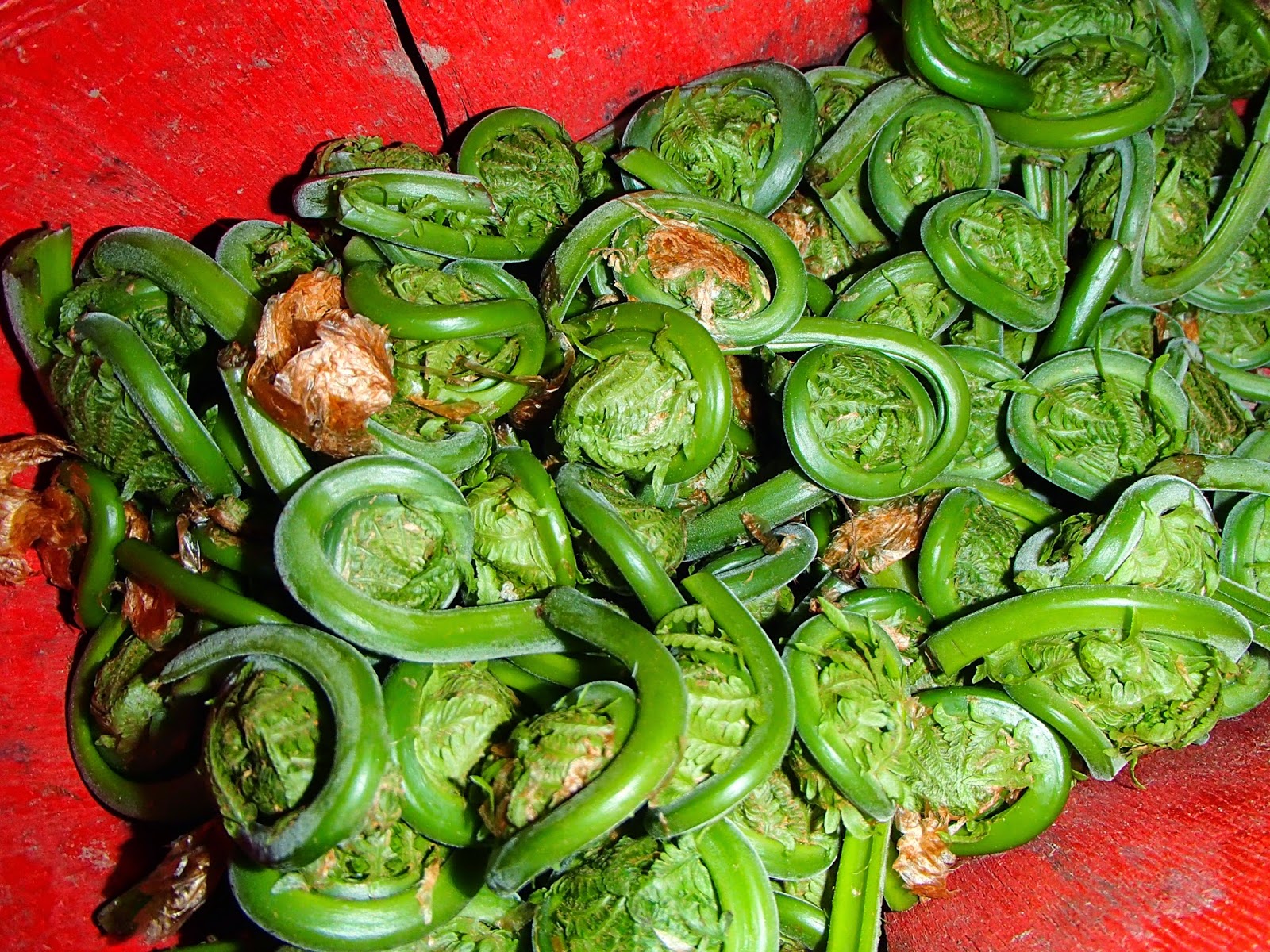
This time of year, our foraging activities continue and this week it was time to pick Fiddleheads (also an addition to "Gifting Berries").

Fiddleheads are the unfurled leaves of the Ostrich Fern. Just as the Ramps, our wet forest floor has gifted us another great food. This one we tend to find on mossy ground among the Skunk Cabbage.

Fiddlehead "hunting grounds" among the Skunk Cabbage
They are not difficult to find as they tend to protrude from last year's growth. So all you really need to find to get started is the old remains of last year's ferns.

The Fiddlehead
We did not pick any last year except for our own consumption. This year, we picked a touch more so that Chef could pickle them and our customers could try them.

A Fiddlehead harvest

Fiddleheads should be blanched before using. Once this is done, they can be used just like any other great green.

Chef's Fiddlehead Pickle....sometimes part of our charcuterie plate

One of the real pleasures of foraging is finding a great mushroom. 

Last year (thanks to our neighbour) we discovered the Pheasant  Back Saddle Mushroom. We enjoyed it, but it was rather late in the Season to pick and as such a bit tough.

The Pheasant Back Saddle Mushroom

This year, we remembered where to find them and managed to pick a few just in time....they were a real treat (once Chef got his hands on them).


Chef's special "Croque Madame": an open face sandwich with melted cheese, a meddley of mushrooms (including our Pheasant Back) and a fried egg.....finished with a drizzle of Birch Syrup!

With Spring fully underway, we are now extremely busy...but we still have time to enjoy a few things around the farm. So we'll end this week with the photo of a beautiful and ancient flower that adorns the marshes (since we've spent quite a bit of time foraging there). This is the Marsh Marigold.

The Marsh Marigold

Sunday, May 4, 2014

Scapes, Ramps...and the Gift Economy

To view the latest from Ridge Berry Farm visit our new blog and site!

Spring is truly well underway. Wild blooms are out and there is no better indicator than our garlic beds where the scapes are growing strong.

Our garlic bed is starting to turn green

What is even more interesting to us this time of year are some of the wild plants now ready for picking.

The first are the wild scapes. Our land is peppered with a wild spring onion that generates an amazing scape. This is the time of year to pick them. Early Spring, they are tender and stand out against the grass.

Wild Scapes
The taste of the scape is similar to onion or garlic and can be used wherever you use Chive (salad dressings, omelettes, etc.).

Wild Spring Onion scapes when picked
Once picked, we use them both at home and in our Tea Room kitchen. These can be frozen or pickled for future use.

Pickled Wild Scapes (available at our Market)
In fact, one special this week at the Tea room was Braised Rabbit Pasta with Mushrooms....and to top it all, shavings of Artisan Cheese and herbs, including wild scapes.

Braised Rabbit Pasta with Mushrooms...topped with wild Scapes

What is even more exciting for us though are the Ramps (also called Wild Garlic or Bear Leek). We discovered a few patches in our forest last year. This year, we found out we were very lucky to own a swamp! Lucky because these patches of Ramps thrive in moist areas usually where the Trillium grow and we found an abundance of them.

One of our patches of Ramps
Because these patches can be sensitive to over-harvesting, we have been diligent in picking just a small percentage of what is now growing on the forest floor (typically less than 1%). It is our understanding that these plants are illegal to pick in conservation areas and in Quebec, where they have almost been picked to extinction.

Picked and cleaned Ramps

The Ramp is a real delicacy (commanding up to 20$/lb in Toronto...if you can get them). They are peppery and very similar to garlic (although not at all related). The bulbs can be enjoyed like Garlic but for some of us, the leaves can also be the tastiest part. They are Garlicky with a mild sweetness, making them ideal for salads or soups.

Of course, we will be using these in our Tea Room kitchen. Chef has been pickling some for sale at our Market or for use as a side with our restaurant's charcuterie plate.

Chef's pickled Ramps
Now this is where the Gift Economy comes to play.

Having previously posted how we have enjoyed the kindness of neighbours and friends over the past year, we feel it's time to give back.

We have decided this year that our fresh produce would become part of the "Gift Economy". There is no reason for good healthy food to be unaffordable...particularly when we see so much locally grown food go to waste.

Our society's effort to generate cheap food means that $/calorie count more than any potential impact this food might have on health or environment. Hence our recourse to industrially produced and genetically manipulated grains and soy.

Market prices are also skewed by quotas, marketing boards and various government restrictions.

So what are we going to do about this? We call it "Gifting Berries".

A selected amount of every fresh produce we harvest from the farm will be put for sale every morning at our Market. But the price will not be specified. It's all up to our customers. We will take what our client believe the produce is worth to them and what it is they can afford. We will also accept payment "in kind".

We believe that this is the only way to 1) identify the real local "market price" and 2) get people to try new, local and healthy food alternatives.

Scapes and Ramps now for sale every morning (and part of the Gift Economy).
Finally, we'll end this week with a quick announcement. Now that the Tea Room is open, we are taking reservations for Mothers' Day. The restaurant is rapidly being booked up, so do not miss this event since every Mom invited for lunch will be given a special free gift from Ridge Berry Farm.


Sunday, April 27, 2014

Tea Room Opening May 1st

To view the latest from Ridge Berry Farm visit our new blog and site!

Well we're finally at the point of re-opening the Tea Room and Market for the Season.

At this point, we really have to thank Mayor Dave and his staff for helping us meet our deadlines. The final results, designed by our local contractor (Tucker Construction) look simply superb.

The new Tea Room
The installation of patio windows allow us to provide some protection from wind, rain and insects, while opening up fully to give that great experience of dining outside.

For the month of May we will be open Wednesday to Sunday from 11AM to 7PM. This schedule will be extended to 7 days a week in the Summer months.

We still have a lot of work to do in the coming week, but we're prepared. Chef has worked out our Spring menu:


Table d`Hote High Tea   ...  includes a Selection of  Tea,
Assorted tea sandwiches  (Watercress on brioche with cream cheese, Curried chicken salad on dark Austrian bread, Egg salad on sourdough bread, Prosciutto and Five Brothers cheese with ice wine mustard on white bread); Hard boiled St. Ann's quail egg; Cream raisin scone with preserves and whipped cream; Mignardises and sweets (truffles, seasonal fruit tart, jellies and cookies)

Impromptu seasonal soup 

Green Salad from Herbs by Daniel and the farm with ice wine mustard vinaigrette

Mennonite summer sausage sandwich, lettuce, on sourdough, with soup or salad 

Warm salad of braised mushrooms, little salad from Herbs by Daniel and a soft poached egg and brioche croutons  

Open faced egg salad sandwich on sourdough with Niagara prosciutto, served with soup or green salad with ice wine mustard vinaigrette  

House made and Ontario charcuterie plate, sourdough, ice wine mustard and pickles

Sweet Plate  (a selection of our Mignardises)

Cream and raisin scones, preserve and whipped cream

Of course we will also have daily seasonal specials and deserts based on what is available from the farm and local producers.

As we begin the new Season, we're also proud to have been certified by FeastON, a new program sponsored by the Ontario Culinary Tourism Alliance. FeastON promotes establishments dedicated to using local foods (our basic operating principle).

The Tea Room is now certified by FeastON for 2014

On another front, it was time to finish our Birch syrup. This process is identical to that of Maple syrup. However, since the syrup is so dark, we decided to double filter before the finishing stage.

Double filtering the Birch syrup
The critical thing about Birch syrup is its rapid tendency to burn. As such, a very watchful eye is needed as the syrup approaches 104 degrees C.

Finishing the very dark Birch syrup
The final product this year has a strong taste of prunes with a molasses finish, perfect for meats and barbecue sauces. 


Birch syrup, bottled and just about ready for sale
Just like our Maple syrup, the Birch syrup will be offered for sale at the Market.

We will leave you this week with a picture of our first Strawberries. Yes they're already coming out...in the Growing Dome that is.


Our first Growing Dome Strawberries


Sunday, April 20, 2014

Finishing Maple and Black Walnut Syrup

To view the latest from Ridge Berry Farm visit our new blog and site!

First we'd like to wish everyone a Happy Easter. Although we had a surprising snow fall this week, it is really beginning to feel like Spring.

This week we decided to stop the tapping of our Maple trees and start finishing our syrup. Technically we probably could have collected sap a bit longer, but we were also keen to start on our Birch trees as well.

Our objective this year was to increase our Maple syrup production and we certainly managed this by tapping a few more trees. Our process was changed however since we did this as a single batch. We acquired a large 60 litre pot to which we continuously added sap as it was evaporated. The entire thing was heated by a propane burner.

Our batch processing set-up for Maple syrup
As we continuously added sap each and every day of our collection, it slowly took on a dark amber shade. Once the container was half evaporated on the last day of collection, it was time to finish the syrup indoor.

We had filtered every batch of sap, but before finishing the syrup we filtered it again to prevent the occurrence of Maple sand (the crystallization of natural  minerals like calcium and magnesium).

Second filtration of the Maple sap
One of the obvious findings this year is that the syrup would turn dark. We also noticed that the sap had a very high sugar content (just handling it off the trees made our fingers sticky). We also noticed that some of our trees generated a yellowish sap which was the sweetest of all (we had to try it). Perhaps the trees this year stored much sugar than last year, as a result of the bitterly cold Winter.

Differences in sap colour seemed to also indicate differences in sugar content
Back in our professional kitchen, we loaded our sap after final filtration and started another boil. We used a candy thermometer to monitor the progress in syrup production.

The kitchen set-up for syrup finishing
The point at which the syrup is done is when the boil is sustainable at 4 degrees C above the boiling point of water (104 degrees C at sea level...which proves good enough for us in the Niagara Peninsula). For those at significant altitude, all you need to do is first boil water to determine its boiling temperature and then add 4 degrees to this.

One of the things we did notice is that you can almost tell things are done by sight. When the sap boils at 100 degrees C, the movement is rapid and turbulent. When the syrup stage is reached, a massive amount of small bubbles are created on the surface.

Boiling at 100 degrees C
Boiling at the syrup stage
After quickly getting the syrup off the stove, it was time to bottle. We're really pleased with the finished results and will be selling these at the market.

Ridge Berry Farm Maple syrup: "cuvee" 2014
With the Maple syrup done it was also time to conclude our Black Walnut syrup experiment. Having tapped a couple of trees, we really wanted to see if this syrup is also worth producing.

The process is identical to making Maple syrup, however it should be noted that Black Walnut syrup consists of both fructose and sucrose (Maple is primarily sucrose). Our Birch syrup experiment last year proved that fructose was much more sensitive to heavy boiling in the finishing stage (and as such easy to burn).

We noticed that the Black Walnut was also sensitive but perhaps not as much as Birch.

So what did we end up with....3 little jugs of a fine syrup which was surprisingly good with some floral and nutty tones (not the heavy Black Walnut taste we were expecting).

Our Black Walnut syrup
The ratios of sap to syrup turned out to be similar to Birch (roughly 80 to 1). As such, Black Walnut syrup is an expensive product to make. Things are a bit worse than Birch since it seems that Black Walnuts do not produce as much sap (although we still need to look into the timing for tapping these trees).

In the end, this was an experiment worth completing and next year we expect to have Black Walnut syrup on our market shelves.

With this work complete, we could now look forward to Birch syrup production. Last year was an experiment, this year we aim to produce enough to sell.

Tapping Birch
On a final note this week, someone decided to drop off some apples and some great apple cider at the side of the barn....Thank You!

The latest "freebie" dropped off at the barn
Over the past year we have really benefited from the kindness of friends and neighbours. We have received everything from Apples, Quinces, Peaches, Grapes, Nuts, etc.  even help with snow removal.

This has given us an idea. We will not discuss it now, but you can expect an interesting announcement in June, when our first berries are picked.

We will conclude this blog entry with a quick photo taken this week. Hopefully this will be the last snow we see in a long while.

Pelham in mid-April???